The iAgentic Platform
A unified governance system that turns experimental AI into a reliable, governed enterprise asset.
Runtime Decision Schema
A standardized data contract that ensures consistent governance across disparate LLM providers and internal agent runtimes.
Mandatory tenant_id and user_id fields ensure strict multi-tenant isolation.
Captures normalized intent and risk_score to drive deterministic policy branching.
Dynamic injection of role, department, and data_sensitivity.
Four deterministic outcomes: ALLOW, DENY, PENDING_APPROVAL, or FILTERED_ALLOW (proceed with data scope restrictions).
{
  "tenant_id": "ent_9921",
  "user_id": "usr_alpha_01",
  "intent": "financial_query",
  "model": "gpt-4-turbo",
  "tokens_in": 142,
  "risk_score": 0.85,
  "context": {
    "role": "analyst",
    "sensitivity": "high"
  }
}IF intent == "financial_data_access" AND user.role != "finance_admin" AND data.sensitivity == "P1" THEN ACTION: REQUIRE_APPROVAL
High-Level Policy Model (DSL)
Intent-based governance that allows for rapid creation and deployment of new rules as regulatory and business requirements evolve.
Business-First Logic
Defined by intent, not low-level technical parameters.
Conditional Enforcement
Deterministic IF-AND-THEN model for complex scenarios.
Granular Control
Target specific models, roles, or data sensitivity levels.
Pluggable & Evolvable
Vendor-independent governance that scales with you.
Proportional Governance
Not all AI actions carry the same risk. iAgentic applies governance proportional to the action's sensitivity — preventing governance from becoming a bottleneck for routine operations while maintaining full oversight for sensitive actions.
Governance that scales with risk, not one-size-fits-all enforcement that slows everything equally.
| Action | Tier | What Happens |
|---|---|---|
| LLM reasoning (thinking) | Lite | Decision recorded, ~5ms overhead |
| Reading public data | Standard | Decision recorded with full context |
| Writing to internal systems | Standard | Full policy evaluation + evidence record |
| Accessing confidential data | Full | Policy + approval workflow + evidence |
| Modifying regulated records | Full | Multi-approver approval + compliance evidence |
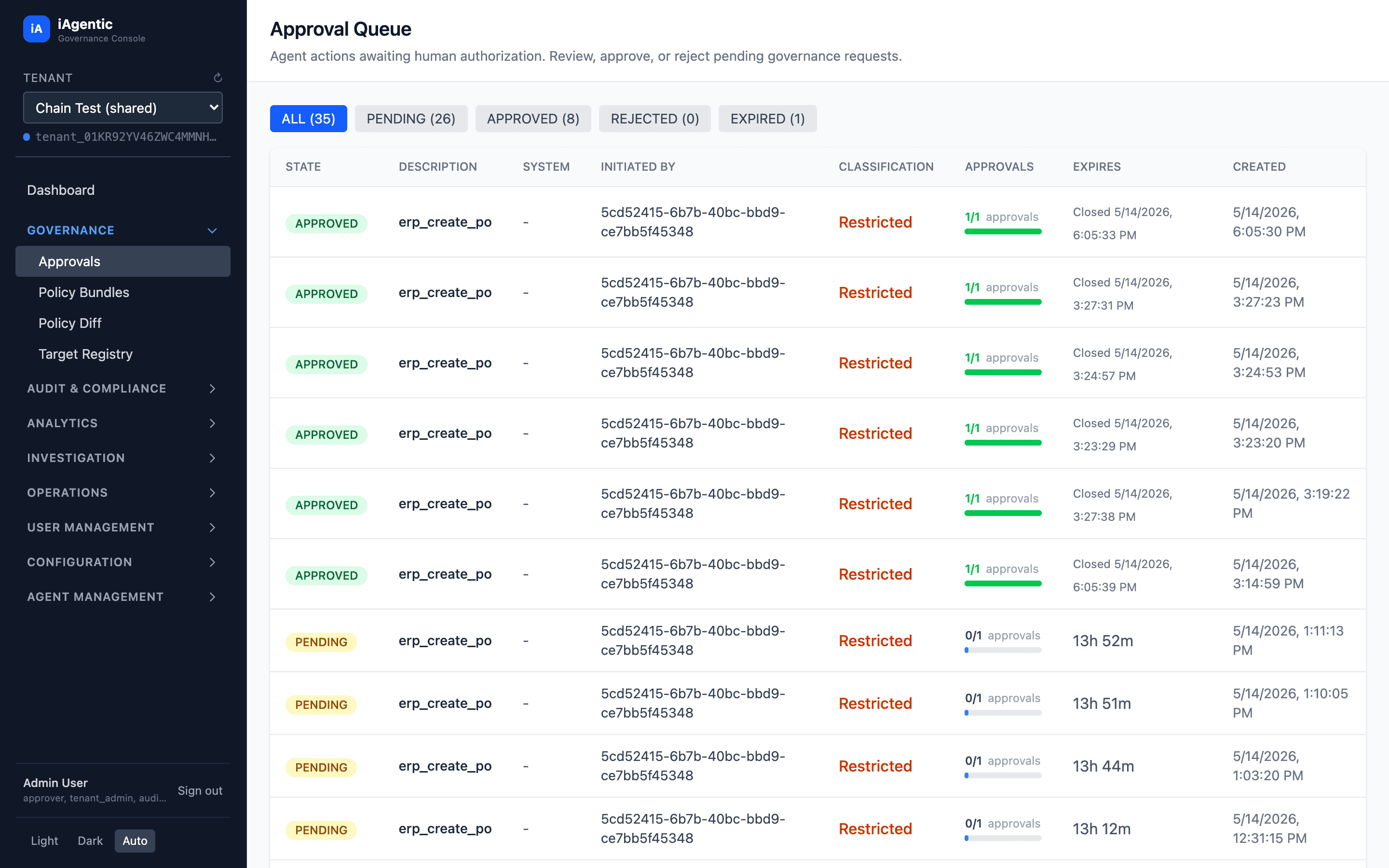
Human-in-the-Loop (HITL)
A stateful state machine for managing high-risk AI decisions that require human intervention without blocking your entire workflow.
Non-Blocking Architecture
System remains responsive while high-risk requests are paused.
Asynchronous Resume
Flow resumes from suspension without client-side retries.
Timeout & Escalation
Automated timers trigger escalation paths based on SLAs.
Full Context Persistence
Entire request state stored for reviewer visibility.
Zero-Trust Agent Identity
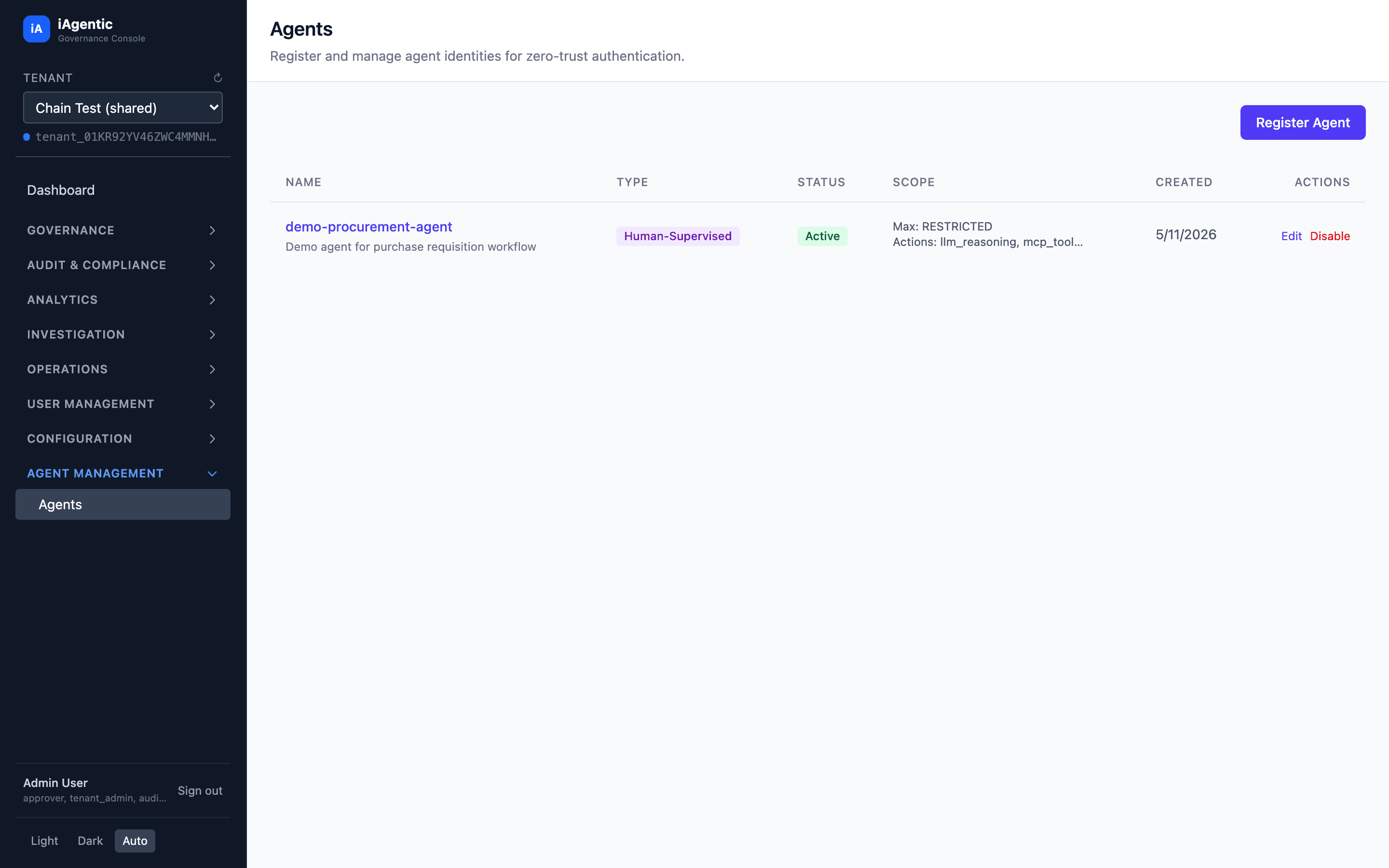
Every agent authenticates as a verified machine identity via standard OIDC client credentials — the same identity infrastructure as human users. No anonymous execution. No shared API keys.
Per-Agent Scoping
Each agent is provisioned with explicit scope: allowed actions, allowed targets, and maximum data classification.
Per-Agent Rate Limiting
Request quotas enforced per agent identity. A compromised or runaway agent cannot consume resources beyond its allocation.
Credential Lifecycle
Issue, rotate, and revoke agent credentials without touching agent code or deployment. Revocation is immediate.
Human-Supervised Enforcement
Agents that can reason autonomously but require a verified human identity token before executing write operations.
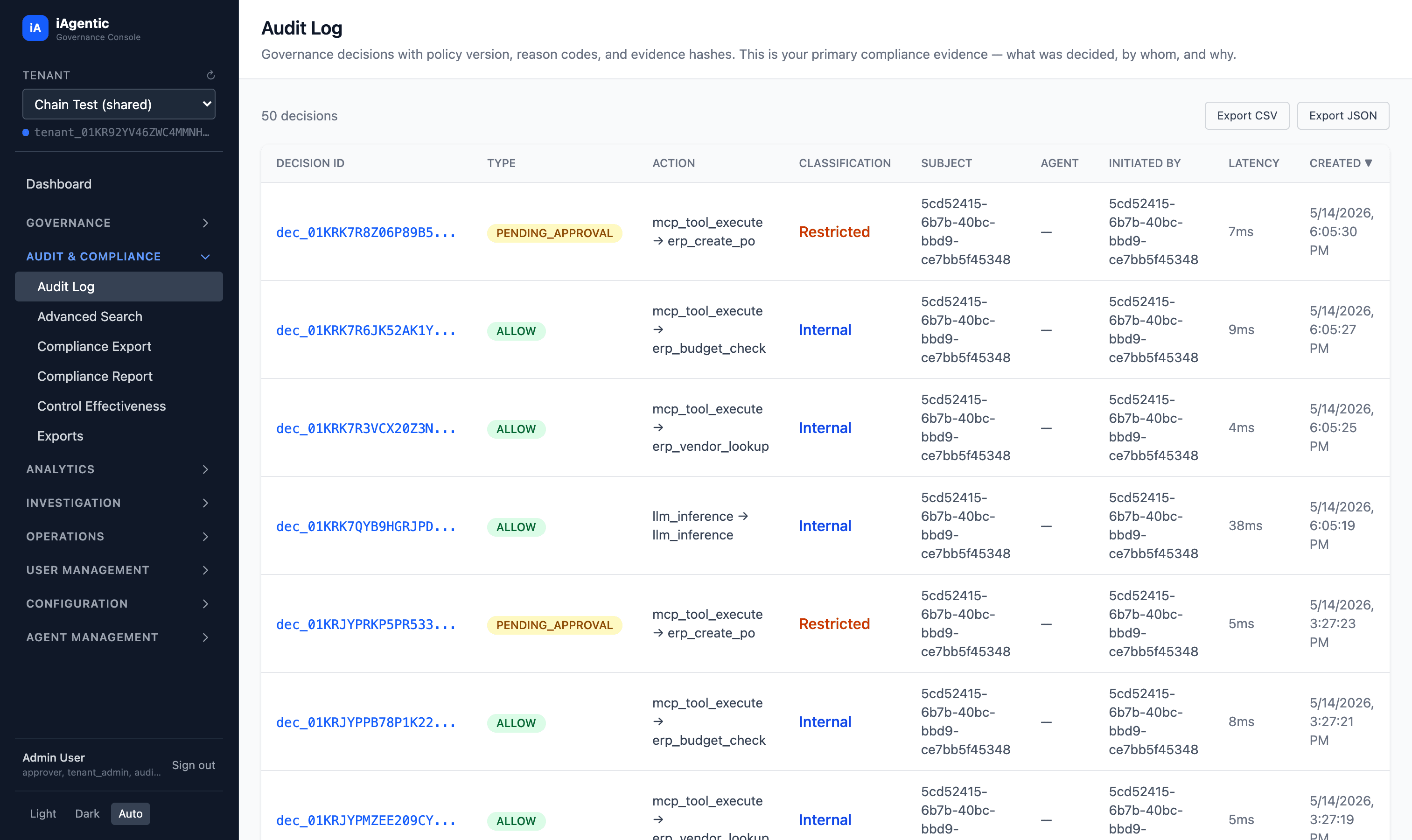
Decision Graph & Traceability
Capturing the immutable justification behind AI interactions. Node-based traceability provides a clear record for auditing AI-driven actions.
Moving from fragmented logs to a structured decision graph for enterprise auditability.
Performance & Compatibility
LLM reasoning governance
Sensitive action governance
Per control plane instance
OpenAI-compatible REST API. No proprietary integration required.
AI FinOps — Cost Visibility & Budget Enforcement
Because every AI request passes through governance, iAgentic has complete visibility into token consumption, cost attribution, and spend patterns — without any agent instrumentation.
Token Usage Tracking
Every governed request records actual token consumption: input, output, cached, and reasoning tokens from the LLM provider’s response.
Cost Attribution
Costs attributed by tenant, agent, model, provider, action type, data classification, and time period. Enables precise chargeback reporting.
Budget Enforcement
Token quotas and rate limits enforced at the governance layer. Requests denied before reaching the LLM provider when budget is exhausted.
Budget enforcement is pre-execution — the request is blocked before incurring cost, not flagged after the money is spent.